September MEPCO Bills: Why the Rs1.99 Relief Ends (2026)
The Rs1.9857 per unit credit that has been cutting MEPCO bills since June was notified for three billing months only — June, July and August 2026. It stops after the August cycle. A fresh quarterly tariff adjustment for April–June 2026 is due to take its place, and NEPRA heard the request on 12 August and reserved its decision. So the September bill loses a discount that was never permanent, and may pick up a charge in the same line where the discount used to sit.
What the Rs1.99 line actually was
It was one quarter’s arithmetic, settled late and passed back to consumers.
NEPRA approved an overall negative adjustment of Rs67.173 billion for the first quarter of calendar year 2026 — January to March — and spread it across three billing months at a uniform rate of Rs1.9857 per kilowatt-hour. The regulator held a public hearing on 19 May 2026 before finalising it. The figure reached bills through S.R.O. 953(I)/2026 and applies to every DISCO and to K-Electric alike.
The money came back because the sector had overcharged against reference assumptions on capacity charges, variable operation and maintenance, use of system charges, market operator fee, and the effect of transmission and distribution losses on monthly fuel costs.
Two points most coverage skipped. First, this sat on top of your slab rate — it never changed the rate itself. Second, it was written with an expiry date from the day it was signed. Nothing is being taken away in September. A three-month window is closing on schedule.
The quarter before it ran the other way: a positive Rs0.3504 per unit, worth Rs8.674 billion, recovered from consumers in the March, April and May 2026 bills under S.R.O. 459(I)/2026. Same mechanism, opposite sign.
Where the line sits, and what its absence looks like
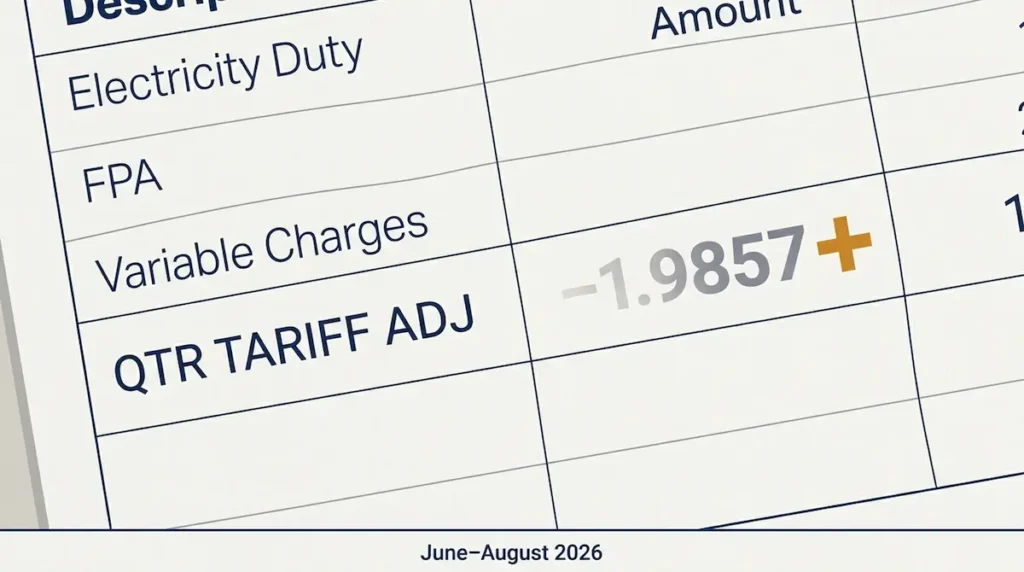
On the PITC bill, the quarterly adjustment appears as QTR Tariff Adj, sometimes printed alongside DMC. Through June, July and August it carried a minus sign, because a credit is shown as a negative figure against your units billed.
From September, one of three things happens on that line:
- It shows nothing. NEPRA has not yet notified the replacement, and its own notifications state that where a bill is issued before the decision is notified, the adjustment may be applied in a following month. A blank QTR line in September does not mean the charge has been waived.
- It shows a positive figure. The April–June quarter has been approved and is now being recovered.
- It shows two quarters at once, later. If the notification lands mid-cycle, the arrears reach you in October or November instead.
The practical consequence: the line you have been reading as a discount for three months becomes a charge without changing its name or its position on the page.
What is due to replace it
CPPA-G filed on behalf of the ex-WAPDA distribution companies for the second quarter of CY2026, covering April to June. The original claim was Rs23.031 billion, later revised upward to Rs33.778 billion — about Rs1.34 per unit over three months.
The composition is worth seeing, because it explains why the number moved the way it did:
| Component | Amount claimed |
|---|---|
| Capacity charges | Rs46.280 billion |
| Variable O&M | Rs4.936 billion |
| Use of System Charges and Market Operator Fee | minus Rs13.517 billion |
Capacity payments — what the country owes power plants for being available, whether or not their electricity is used — are the whole story. At the hearing, the distribution companies reported that domestic and commercial sales had fallen sharply, blaming solarisation, an unusually cool April and lower agricultural demand. Fewer units sold means the same fixed obligation is divided among fewer kilowatt-hours, so the per-unit figure rises.
Industrial representatives objected that a further increase would damage manufacturing competitiveness and asked the regulator to defer part of the claim. NEPRA reserved its decision and said it would rule after examining the data.
Worth knowing before you assume Rs1.34 is final: the regulator has trimmed every recent request it reviewed. Distribution companies asked for Rs1.7251 per unit on the April fuel adjustment and received Rs1.1907. They asked Rs1.20 on the June fuel adjustment and received Rs0.75.
The size of the swing, in rupees
Two scenarios bracket what September and the two months after it can look like. The GST on your bill applies over the adjusted total, so both figures below include it at 18%.
- If NEPRA rejects the claim outright — only the credit disappears: about Rs2.34 per unit.
- If NEPRA approves it in full — the credit goes and a Rs1.34 charge arrives: a swing of Rs3.3257 before tax, about Rs3.92 per unit.
| Monthly units | Credit ends only | Credit ends + full QTA |
|---|---|---|
| 200 | ~Rs470 | ~Rs785 |
| 300 | ~Rs700 | ~Rs1,180 |
| 500 | ~Rs1,170 | ~Rs1,960 |
The realistic outcome sits between those columns. If you want your own figure rather than a band, put your last month’s units into the bill calculator twice — once with the quarterly adjustment field at −1.9857 and once at +1.34 — and the gap between the two totals is what this transition costs your household.
September carries a second variable
The quarterly adjustment is not the only line moving. The fuel adjustment runs on its own two-month lag, and September bills carry the July 2026 fuel charge.
Recent months, for context: June bills carried April’s fuel adjustment at Rs1.1907; July bills carried May’s at Rs0.34; August bills carried June’s at Rs0.75, approved after a hearing on 29 July to recover Rs9.8 billion. CPPA-G had cited a reference fuel cost of Rs7.71 per unit against an actual Rs8.91, driven mainly by imported LNG.
So a September bill can move on both lines at once, in the same direction. When you compare it against August, separate the two before deciding something is wrong.
Who sees no change at all
The quarterly adjustment never applied to lifeline consumers, to prepaid connections, or to units billed under the incremental consumption package. Households in those categories received nothing from the June–August credit and will pay nothing when the next quarter is recovered. Their September bill moves only if their units move.
One recent change worth noting: the June fuel adjustment notified for August billing excluded protected consumers as well as lifeline, prepaid and EV charging stations. Fuel and quarterly adjustments carry different exclusion lists, and those lists have not been fixed from quarter to quarter. Read the exclusions on the line printed on your own bill rather than assuming last quarter’s rules carried over.
Reading your September bill without misjudging it
Compare September 2026 against September 2025, not against August. August contained a Rs1.9857 credit that no other month this year will contain, which makes it an unusually flattering baseline.
Then look at three things in order: the units billed, the rate in the Rate column, and the QTR Tariff Adj line. If units and rate are both unchanged from August and the total has risen, the adjustment lines account for the difference and the bill is correct.
If your rate itself has changed, the adjustment is not your answer — something has moved in your consumer status, and that is a separate matter entirely.
FAQ
Is the Rs1.99 relief being cancelled early?
No. It was notified for the June, July and August 2026 billing months and is finishing its full term.
Can both quarterly adjustments appear on one bill?
The old one cannot return. When NEPRA approved a new quarterly adjustment in March 2024, the existing ones ceased from the date the new one took effect — they replace each other rather than stacking. Arrears of a single delayed quarter can appear late, however.
Will MEPCO bills differ from LESCO or PESCO?
No. The quarterly adjustment is set as a uniform national rate across all ex-WAPDA distribution companies and extended to K-Electric under federal policy guidelines. Multan, Bahawalpur and Rahim Yar Khan pay the same figure as Lahore.
Can I dispute the QTR Tariff Adj line?
Not the rate — NEPRA sets it and no distribution company can alter it. What can be disputed is its application: wrong units, or a charge applied to a connection in an exempt category.