MEPCO Bill QR Code: What It Is and Why to Scan It
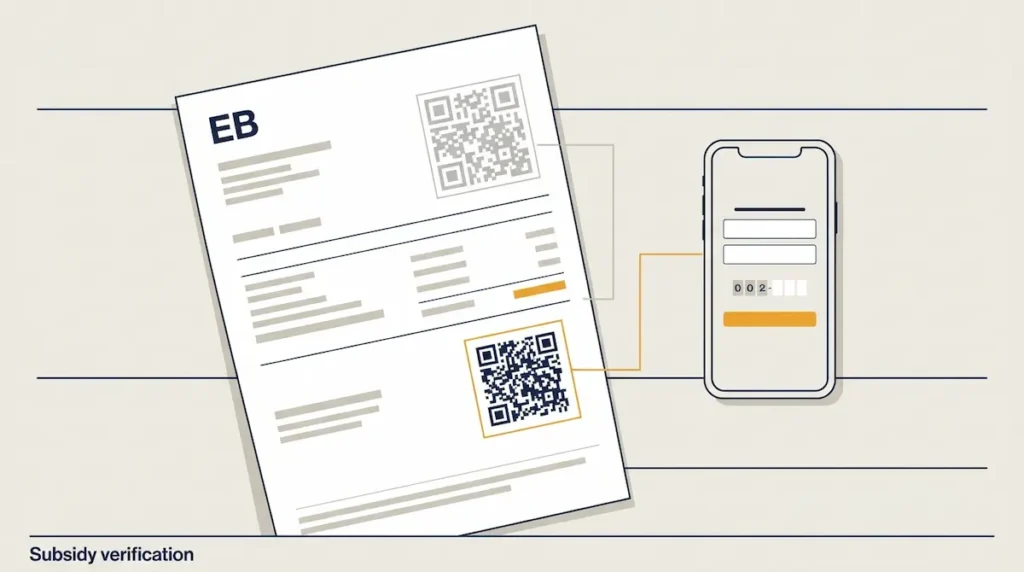
The QR code on your MEPCO bill is a subsidy verification link, not a discount. Scanning it and completing registration keeps the government subsidy already on your bill; it does not add a new one. The registration asks for your 14-digit reference number, your CNIC and a one-time code sent to the mobile number registered against your connection. It is free, takes a few minutes, and is required to keep protected-rate billing running without interruption.
First, work out which code you are looking at
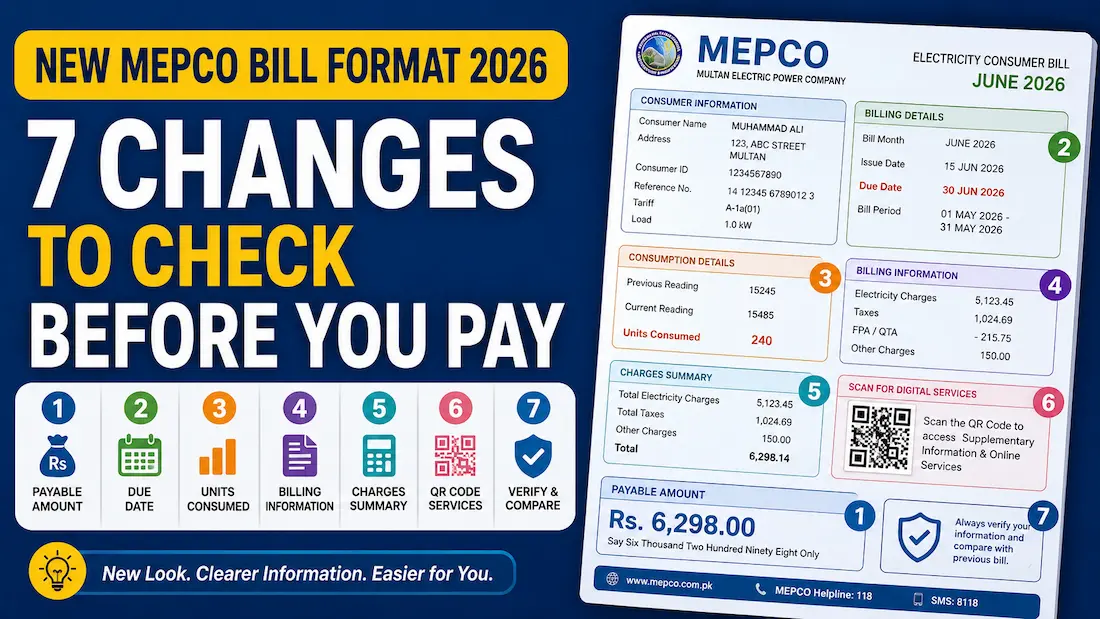
MEPCO redesigned its bill in June 2026 on directives from the Power Division. CEO Engineer Gull Muhammad Zahid described the new layout as putting the payable amount, due date and units in a clearer order — and QR codes are part of that redesign.
That redesign means a bill can carry more than one square code, and they do opposite things.
The test is where the code lands, not how it looks. Scan it and read the address bar before you type anything:
- If it opens your banking or wallet app with your payable amount already filled in, that is a payment code. Nothing to do with subsidy.
- If it opens a web page asking for your reference number and CNIC, that is the subsidy registration.
Scan first, look second, type third. That order alone prevents most of what goes wrong.
The subsidy figure now printed in rupees
The other half of the May 2026 change is quieter but more useful. Distribution companies were instructed to state the exact subsidy amount on each monthly bill, so the relief stops being buried inside the net rate.
This matters because most households never knew the size of what they were receiving. Between March 2024 and May 2026, the all-inclusive rate for protected consumers using up to 200 units fell from Rs24.07 to Rs16.56 per unit, against a national average of Rs42.26. The number now printed on your bill is roughly the gap between those two worlds, applied to your units.
Read it once. It is the figure the registration is protecting.
What the registration actually asks for
Four things, in this order:
- Your 14-digit reference number. If you do not have a paper copy to hand, pull it from your MEPCO bill online before you start.
- Your CNIC number.
- Confirmation of the connection details the portal displays back to you — name, address, distribution company.
- A one-time code sent by SMS to the mobile number registered against the connection.
There is no fee, no form to download, no office visit and no agent involved at any point. If someone asks for payment to complete this, they are not part of the process.
Why a subsidy portal asks for your CNIC when a bill lookup never does
This trips people up, and the confusion is reasonable.
Checking a bill is a lookup. The reference number is the key, and any site demanding your CNIC to show you a bill is behaving suspiciously.
Registration is the opposite kind of transaction. The government is not showing you data — it is deciding whether a specific person is entitled to public money at a specific address. That requires identity, which is why CNIC and the OTP exist. The stated purpose is to stop repeated claims through several meters at one property, and connections are now being tied to one meter per CNIC through national welfare records.
So the rule to carry is simple. A page that wants your CNIC before showing you a bill is wrong. A page that wants your CNIC to register you for a subsidy is doing its job — provided you reached it from the code printed on your own bill.
Telling the real portal from the copies
On 22 May 2026 the Power Division issued a public warning that criminals were misusing QR codes and links to harvest consumer data, walking people through a four-step form and then asking for a six-digit code. The advisory told consumers not to enter their details anywhere except official channels reached directly from their bill.
That six-digit code is the detail worth memorising. A one-time code is what proves your identity. Handing it to the wrong page hands over the connection it was protecting.
Three checks, in order of usefulness:
- Reach the page from your own bill. A code printed on paper delivered to your address cannot be swapped remotely. A link forwarded on WhatsApp can.
- Read the domain, not the page design. Copies imitate the layout closely and buy near-identical names.
- Refuse any WhatsApp group, Facebook page or phone number offering to complete it, check your status, or guarantee approval. None of those is part of the official route.
What happens if you do nothing
Nothing sudden. There is no single national cut-off date, and the drive has been running continuously since May, distribution company by distribution company — FESCO alone confirmed 1.71 million completed registrations by late July.
What the Power Division has said repeatedly is that verified consumers keep their subsidy without interruption, and that unverified accounts risk disruption or withdrawal. Around two million single-phase consumers had registered by the end of May, out of a protected population that has grown from 9.5 million in FY2022 to 21.5 million in 2026. The remainder is the group the verification exists to sift.
If protected status is lost, reported per-unit costs move from roughly Rs17–20 to Rs38–40. On a 180-unit household that is the difference between a manageable bill and a painful one, repeated every month until the status is restored.
Where registration fails, and what to do
- The OTP never arrives. The number registered against your connection is not the number in your hand. This is the single most common blocker, particularly on connections inherited from a previous owner or landlord. Update the mobile number against your account first, then register.
- The name does not match your CNIC. Consumers have been advised to make sure the name on the bill matches CNIC records. Where a connection is still in a deceased relative’s or previous owner’s name, the change of name has to happen at your Sub-Divisional Office before registration will pass.
- Two meters at one address. Only one connection per CNIC now attracts the relief. If a family has been running two meters at one property, register the one actually lived on and expect the other to be treated on its own merits.
- Renting. The connection is not in your name, and registration follows the connection. Speak to the owner rather than registering someone else’s CNIC against it.
If there is no smartphone in the house
Two routes exist. Registration can be completed manually on the Cross Subsidy Program portal without scanning anything — the code is a shortcut, not a requirement. And facilitation desks have been set up at district administration offices and union councils specifically for consumers without smartphones or without confidence using them.
An elderly parent on a protected connection should not be left to work this out alone. Someone in the family should sit with the bill and do it once.
FAQs
Will scanning reduce my bill?
No. It preserves the relief already applied. Nothing new is added.
Does it cost anything?
No, at any stage.
Do I have to repeat it every month?
No. It is a one-time verification of the connection.
Is this the same as the subsidy line on my bill?
The line shows the money. The code protects it. They are two halves of the same change.